
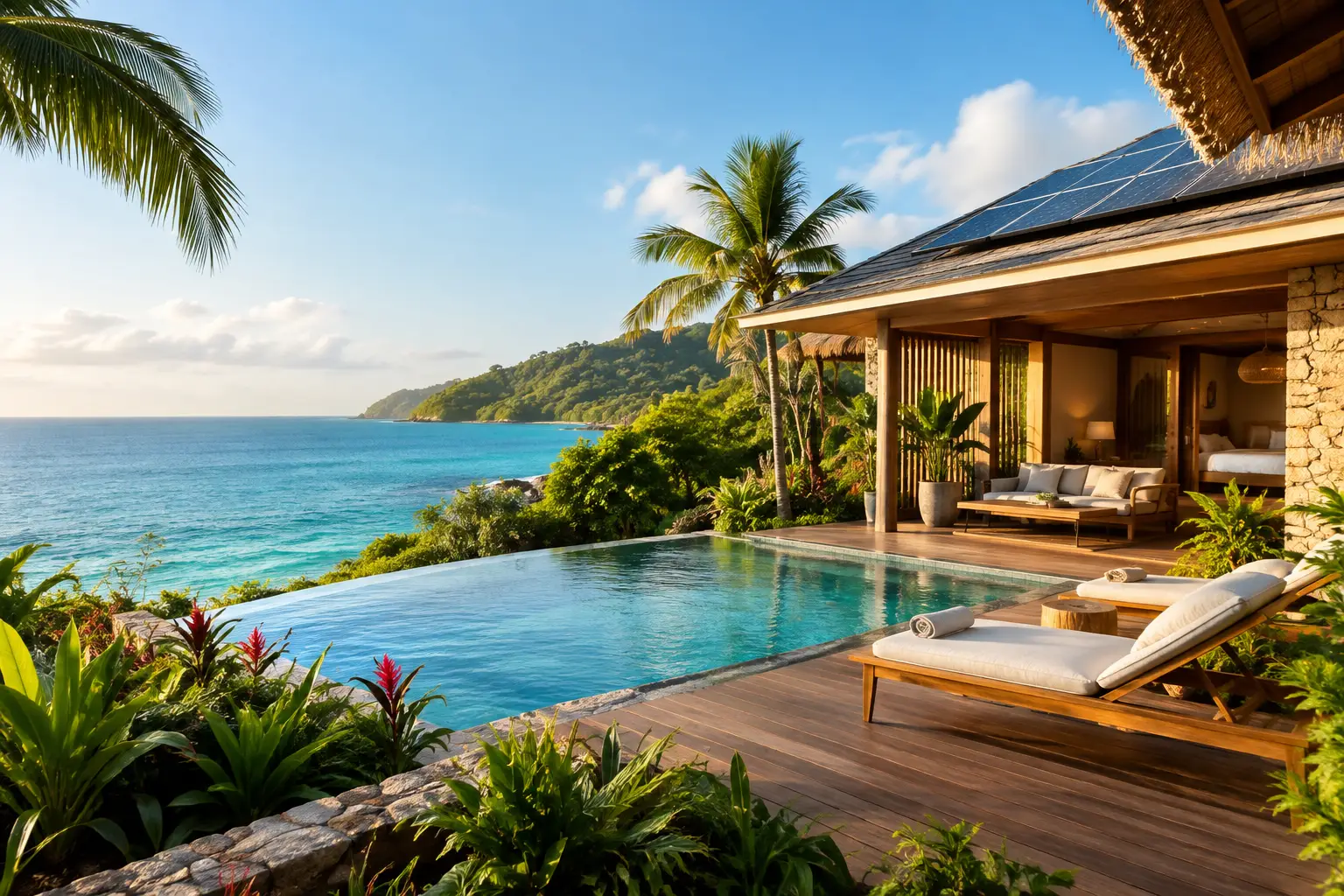
Caribbean Sustainable Resort Design That Endures
A resort’s most expensive decisions are often made before the first villa is framed. The orientation of a building, the location of plant rooms, the treatment of runoff, and the choice between imported finishes and regional materials will shape guest comfort, operating costs, and long-term value for decades. Caribbean sustainable resort design is therefore not an aesthetic overlay or a collection of environmental features added at the end. It is a disciplined approach to creating exceptional hospitality assets that belong to their setting.
For developers, land investors, and hospitality owners, sustainability has become a practical measure of quality. Sophisticated guests increasingly expect privacy, beauty, and intuitive comfort without visible waste. At the same time, island conditions demand resilient systems, thoughtful resource management, and a design strategy that can perform through heat, salt air, heavy rainfall, and seasonal weather patterns.
Caribbean Sustainable Resort Design Starts With the Site
The highest-value sustainable decision is often selecting the right site and allowing it to inform the project. A dramatic beachfront parcel may hold enormous appeal, but the most compelling development plan is not always the one that places every key space closest to the water. Setbacks, existing vegetation, drainage patterns, coastal access, and elevation all deserve careful study before a master plan is finalized.
A well-conceived resort works with the natural landscape rather than forcing the landscape to accommodate it. Mature trees can provide meaningful shade. Existing contours can guide roads and pathways. Native planting can reduce irrigation demands while preserving the sense of place visitors travel to experience. On steep or sensitive sites, a lighter-touch approach with smaller building footprints may protect the land and create a more private, exclusive guest experience.
This is where restraint can become a luxury advantage. Fewer, more thoughtfully positioned keys may deliver stronger privacy, clearer views, and a calmer arrival sequence than a denser plan. The right balance depends on the market, the brand, the access point, and the intended operating model. There is no universal formula, but there is a clear principle: protect the qualities that made the land valuable in the first place.
Design for Shade, Airflow, and Comfort
In the Caribbean, passive design is not nostalgic. It is intelligent engineering. Buildings positioned to capture prevailing breezes can reduce dependence on mechanical cooling in open-air lounges, restaurants, reception spaces, and circulation areas. Deep overhangs, shaded terraces, screened openings, covered walkways, and carefully placed landscaping all help moderate heat before it reaches the building envelope.
This does not mean every resort should look rustic or avoid air-conditioned interiors. Luxury guests expect reliable comfort, especially in bedrooms, wellness spaces, and high-end residences. The opportunity lies in using mechanical systems where they add the greatest value, while designing the rest of the property to feel naturally comfortable and connected to the outdoors.
Orientation matters as much as materials. Western exposures can be beautiful at sunset but punishing in the afternoon. Large expanses of glass may frame extraordinary water views, yet they require shading, high-performance specifications, and a coordinated cooling strategy. The most successful projects do not treat these choices as competing objectives. They design for both visual drama and measured performance.
Build for Island Conditions, Not a Brochure
Salt, humidity, ultraviolet exposure, and wind can diminish poorly specified materials with surprising speed. Sustainable design requires a long view of maintenance and replacement cycles. A finish that photographs beautifully at opening may become an operational burden if it cannot withstand the climate or be repaired locally.
Durability is an essential part of responsible resort design. This can include corrosion-resistant hardware, properly detailed roofing systems, protected glazing, elevated critical equipment, and exterior materials selected for their ability to weather gracefully. In coastal environments, hidden details matter. How balcony edges drain, how metal meets masonry, and how service areas are ventilated can affect the life of the entire asset.
Locally available and regionally familiar materials can offer practical benefits beyond their visual authenticity. They may be easier to source, repair, and maintain over time. They can also reduce the design disconnect that occurs when a resort feels interchangeable with a project anywhere else in the world. That does not require an overly literal interpretation of island architecture. Contemporary design can be deeply rooted in place when scale, shade, texture, landscape, and craft have been considered with care.
Water Is a Design Issue, Not Just an Operations Issue
Water security deserves to be addressed at the master-planning stage, particularly for properties with pools, extensive landscaping, villas, spas, and food and beverage operations. A beautiful resort can place considerable demand on local resources if water systems are treated as an afterthought.
Thoughtful strategies may include rainwater collection, efficient fixtures, water-conscious laundry planning, drought-tolerant planting, and systems that allow treated water to support landscaping where appropriate. The exact solution will vary substantially by island, site conditions, infrastructure, and property scale. A private-island retreat, for example, may require a more self-reliant approach than a resort connected to established municipal systems.
The guest experience should remain elevated. Sustainable water planning is not about asking guests to compromise. It is about making conservation quiet, intelligent, and integrated into the property’s operation. Landscaping that thrives with less water often looks more natural and enduring than high-maintenance tropical displays that struggle outside their ideal conditions.
Energy Planning Should Protect the Guest Experience
Resorts consume energy around the clock, and the Caribbean’s climate places significant demand on cooling, refrigeration, lighting, water heating, and back-of-house functions. The strongest approach begins with reducing unnecessary loads through architecture, equipment selection, and building controls before considering onsite generation.
Solar can be a valuable part of the energy strategy, particularly where roof area, orientation, and local conditions support it. But panels alone do not make a property sustainable. Energy performance also depends on efficient cooling systems, insulation, shading, lighting controls, kitchen equipment, and the ability to monitor how the resort actually operates after opening.
For a luxury property, reliability is non-negotiable. Backup power, energy storage, and resilient mechanical planning may be central to guest confidence and business continuity. These systems require early coordination because they affect space planning, acoustics, visual impact, service access, and capital budgets. They are not elements to squeeze into a completed design.
Make Back-of-House a Priority
A resort’s environmental performance is often won or lost behind guest-only doors. Laundry, kitchens, waste handling, staff facilities, storage, maintenance workshops, and loading areas should be planned with the same seriousness as arrival courts and beachfront lounges.
Well-organized back-of-house operations reduce unnecessary movement, improve staff efficiency, and make it easier to separate waste streams, manage deliveries, and maintain equipment. This is not a glamorous part of a design presentation, but it directly supports margins and service standards. A refined guest experience depends on an operationally coherent property.
Sustainability Must Feel Authentic to the Destination
The most memorable Caribbean resorts offer a genuine relationship with their island. Guests notice when the food program highlights regional producers, when landscape design reflects the local ecology, and when architecture responds to climate instead of copying an international template. Authenticity cannot be purchased through decorative accessories after construction is complete.
Developers should also be thoughtful about how sustainability is communicated. Broad claims can feel generic, particularly to experienced luxury travelers. Specific, visible commitments are more credible: shaded pedestrian routes that make walking pleasurable, restored native habitat, locally informed design details, discreet refill stations, or a culinary program built around seasonal availability.
The goal is not to turn a resort into a lesson. It is to create an environment where thoughtful choices improve the experience. When sustainability is done well, guests may simply feel that the property is cooler, quieter, more private, and more connected to its surroundings.
A Better Brief Creates a Better Asset
Before engaging architects, operators, and consultants, a development team benefits from defining what sustainability means for the particular asset. Is the priority resilience? A lower operating footprint? A distinct wellness positioning? Greater independence from utilities? Protection of sensitive land? Often, it is a combination, but those priorities should be ranked.
That clarity helps prevent costly contradictions later. A design team cannot optimize every objective without trade-offs. Extensive glazing may support a view-led concept but increase cooling requirements. A remote location may deliver rare privacy but demand more complex infrastructure. A low-density plan can preserve the landscape but may alter the economics of amenities and staffing. The right answer is the one that aligns design, operations, guest profile, and investment horizon.
For investors evaluating land, boutique hotels, private islands, or ground-up resort opportunities, early regional guidance is especially valuable. Island Property Group helps clients view an opportunity in its full context, connecting the vision for a property with the local expertise required to assess its path forward. This is not a search experience. It is a considered process for identifying assets with enduring appeal.
The best sustainable resorts do not advertise their discipline at every turn. They let guests feel it in the shade of a terrace, the quiet efficiency of a villa, the health of the landscape, and the confidence that the property was designed to remain exceptional long after opening day.